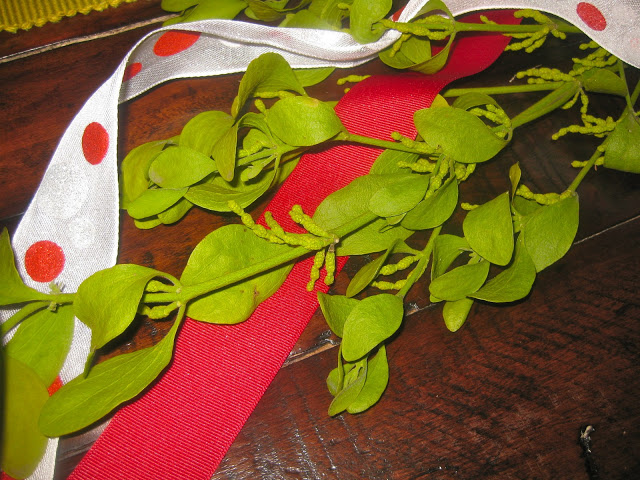
A few years ago, I had no idea that I had decorated my Christmas Day dinner table with the product of bird dung on a twig. We sat around talking about the mistletoe I had snipped out of the tree on my hike through the oaks. Our discussion evolved into the source of my mistletoe — Where does it grow, how does it grow way up there in the tree; is it really poisonous? Where are it’s roots?
Mistletoe is associated with the winter solstice, Christmas, and New Years probably because it is an evergreen in the dead of winter, seen in barren trees that have lost their leaves. High up in the branches, if you spot a ball of greenery , it is most likely mistletoe. Anything that is green and growing during the winter months often symbolizes life — the return of Spring, the return of the sun, and the rebirth of life.
The Druids and Celts were known to call mistletoe the celestial tree, it being rooted high up in the branches of trees, near heaven — a hope in the cycle of rebirth in the dark of winter. That makes sense since you see it easier in the winter when trees have no leaves. It would appear a miracle to ancient cultures that something green grows in a brown tree.
Mistletoe as a parasite:
Mistletoe is an odd name, which dates back to an Anglo Saxon word, meaning dung twig — “mistle tan” — mistle meaning dung and tan for twig.
Some mistletoe springs into life when birds do the planting — by ingesting the white berries and pooping on a twig or a branch of a tree. There you have it — dung on a twig that grows into mistletoe or properly called, viscum album. Thus, Mistletoe is a parasite, another not so lovely thing about this greenery on my table. The plant is not healthy for the tree to which it has attached — mistletoe sends a root system of it’s own down into the host tree, securing nourishment directly from the tree. Too mcuh mistletoe in the a tree will kill it.
Poop origins and a parasite. Oh, and a symbol of male fertility. I’m not sure how the men at your table may feel about this one.
Expulsion of dwarf mistletoe seed
Mistletoe as a fertility symbol:
Mistletoe has another way of reproducing that does not include birds and their poop. The mature seed berry has a tight outer skin, whose contents is under high hydrostatic pressure. It explodes and the inner sticky seed is jettisoned out at speeds of up to 60 miles an hour and up to 30 feet, where it finds a new tree branch to land. I think this is why ancient cultures must have decided it is a male fertility symbol. In Austria it was supposedly placed in a couples bed to encourage conception.
After it’s flight through the air, the sticky seed just hangs out on the twig or branch and in about 6 weeks it germinates, sending out a sprout horizontally along the twig and pushing down into the branch to root and go further down into the middle of the tree to suck out it’s water and nutrients. Then it incubates. It takes 3 to 5 years before green shoots and leaves are produced, which go on to produce the berries. OK, so we get the picture of fertility.
Kissing under the mistletoe:
This may date back to the country of my ancestors — Scandinavia and involve a grand old Norse myth of gods and goddesses and death and resurrection. According to this myth, Baldur is killed by a spear made from mistletoe (which seems unlikely to me, as the plant is not woody or strong enough to make a spear — it’s a ball of soft stems and leaves.) And another god thwarts Baldur’s resurrection. It is odd that anyone would therefore kiss under the mistletoe — maybe it is to bring back life??
There are toxic compounds in the white berries, it so keep it away from the little kids, the pets, and I don’t advise putting it under your pillow. Hang it high and kiss under it.
Used to monitor number of Google Analytics server requests when using Google Tag Manager
1 minute
_ga_
ID used to identify users
2 years
_gid
ID used to identify users for 24 hours after last activity
24 hours
_ga
ID used to identify users
2 years
_gali
Used by Google Analytics to determine which links on a page are being clicked
30 seconds
__utmv
Contains custom information set by the web developer via the _setCustomVar method in Google Analytics. This cookie is updated every time new data is sent to the Google Analytics server.
2 years after last activity
__utmx
Used to determine whether a user is included in an A / B or Multivariate test.
18 months
__utmb
Used to distinguish new sessions and visits. This cookie is set when the GA.js javascript library is loaded and there is no existing __utmb cookie. The cookie is updated every time data is sent to the Google Analytics server.
30 minutes after last activity
__utmc
Used only with old Urchin versions of Google Analytics and not with GA.js. Was used to distinguish between new sessions and visits at the end of a session.
End of session (browser)
__utmz
Contains information about the traffic source or campaign that directed user to the website. The cookie is set when the GA.js javascript is loaded and updated when data is sent to the Google Anaytics server
6 months after last activity
_gac_
Contains information related to marketing campaigns of the user. These are shared with Google AdWords / Google Ads when the Google Ads and Google Analytics accounts are linked together.
90 days
__utma
ID used to identify users and sessions
2 years after last activity
__utmt
Used to monitor number of Google Analytics server requests